
01 · INTRODUCTION
AI adoption in Indian manufacturing jumped from 8% to 22% within a single fiscal year, according to Team Lease data for FY2024, one of the sharpest adoption curves seen in any industrial segment globally. A significant portion of that investment has gone directly into quality control, specifically into automated vision inspection systems that do not just flag bad parts but generate the process intelligence to stop defects before they form. The shift matters because India’s manufacturers are no longer competing only on cost, they are competing on quality, traceability, export compliance and defect-free delivery, where traditional manual inspection cannot hold the line.
02 · THE PROBLEM
Inspection That Arrives Too Late
The structural flaw in conventional quality control is not just human error it is timing. End-of-line inspection, whether manual or rule-based automated, catches defects after the full cost of producing that part has already been incurred. Rework, scrap and the downstream ripple of a non-conforming batch reaching the customer are all consequences of a system designed to sort rather than prevent. Research published in PMC puts average human visual inspection accuracy at around 80% in industrial settings, meaning roughly one in five defective parts escapes detection under normal shift conditions.
For India’s high-volume manufacturers in automotive, FMCG packaging, pharmaceuticals and electronics, this gap is financially significant. According to IMARC Group’s 2025 analysis of the Indian manufacturing quality sector, quality-related losses across precision industries contribute to production cost overruns that compress already thin margins, particularly for plants seeking to qualify for global OEM supplier programmes where incoming defect tolerances are measured in single-digit parts per million.

03 · THE SOLUTION
AI Vision Inspection as a Process Intelligence Layer
The meaningful leap in modern vision inspection is not simply the shift from human eyes to cameras; it is the shift from rule-based detection to AI-driven pattern recognition. Earlier machine vision systems required engineers to hand-code specific thresholds for every defect type: if a dimension falls outside this boundary, reject. That approach breaks down fast when dealing with surface anomalies, texture defects or novel product variants. AI-powered convolutional neural network models, trained on thousands of labelled images of conforming and non-conforming parts, learn what a defect looks like rather than following a written rule, making them dramatically more adaptable and accurate.
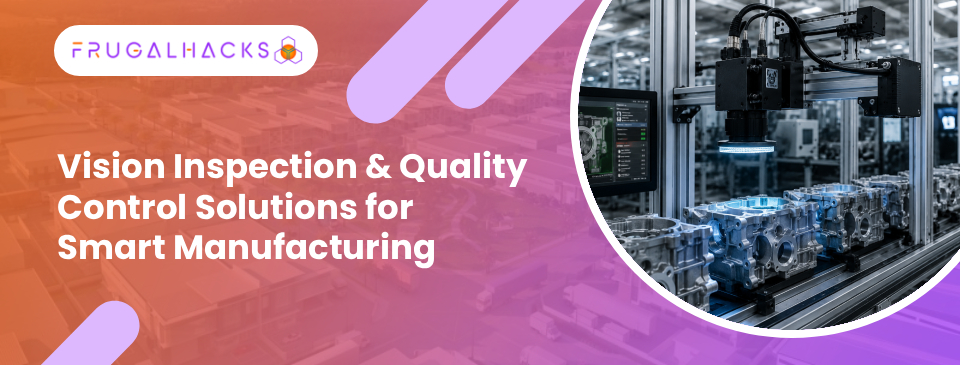
At the production line level, the deployment architecture typically places high-resolution smart cameras at critical inspection stations, connected through a PLC-managed reject mechanism that acts within the same cycle time as the line. Defect images, classifications and timestamps feed continuously into a SCADA or IIoT data layer, where process engineers can identify patterns a cluster of surface cracks correlating with tool wear at a specific machining station, for instance and make upstream corrections before the next batch runs. In BMW’s manufacturing operations, a CNN-based vision system reduced surface and structural defects by nearly 40% while simultaneously adapting to new model variants without requiring full re-engineering of inspection logic. Frugalhacks applies the same inline PLC-vision integration approach across automotive BIW, industrial machinery and FMCG packaging lines in India.

Unlike rule-based systems, AI vision models reduce false positive rates to just 4–10% compared to legacy AOI systems that misclassify up to 50% of inspected parts. Manufacturers regularly recover over 300 hours of inspection labour per application, per month, through this reduction alone.
“The goal is not a system that catches bad parts. The goal is a system that tells you why bad parts are forming and stops it happening again.”
04 · WHY IT MATTERS
Closing the Loop on Quality in Indian Manufacturing
India’s PLI Scheme and the Make in India programme are accelerating the country’s position as a global manufacturing hub, but that position comes with a quality obligation. Export-grade customers in automotive, aerospace and pharma sectors require defect documentation, traceability records and process capability data that manual inspection cannot produce at scale. AI-powered vision inspection systems generate this documentation as a byproduct of normal operation: every part imaged, every defect classified, every reject logged automatically and, in a format ready for ISO, IATF 16949 or FDA audit requirements.
According to NASSCOM’s April 2025 Smart Factory Index, Indian manufacturers that deployed AI-powered automation reported a 45% improvement in Overall Equipment Effectiveness, 30% shorter cycle times and 25% fewer unexpected line stoppages. For a plant manager, those numbers translate to more output per shift, lower cost per unit and a quality record that supports the next tier-one supply chain conversation.
Table 1 Rule-Based vs. AI-Powered Vision Inspection

05 · FAQS
What Plant Managers Are Really Asking
Q. Our current AOI system generates too many false positives, and our team has stopped trusting it. Can AI fix that?
False positives are the silent productivity killer of legacy rule-based inspection they create operator fatigue, erode confidence in the system and cause good parts to be unnecessarily scrapped or re-inspected. AI-powered models trained on your specific part profiles reduce false positive rates to 4–10%, compared to the 30–50% misclassification rates common in older AOI systems. The improvement comes from the model understanding natural part variation versus actual defects, rather than applying binary threshold rules that treat any deviation as a failure.
Q We run a shared line producing multiple SKUs. Can a single vision system handle all variants without a full changeover each time?
Yes, and this is one of the clearest advantages AI visions holds over rule-based systems for high-mix Indian manufacturers. A trained AI model can carry multiple product profiles simultaneously, switching between them based on a PLC signal or barcode read at the entry of each job. For new variants, incremental retraining which involves providing the system with as few as 20–40 labelled images of the new part update the inspection logic without overwriting existing product knowledge. Setup time between jobs drops from hours of engineering work to minutes of model activation.
Q We are a mid-size manufacturer in India. Is building and maintaining an AI training dataset realistic for our team?
This concern is valid but often overstated. Modern AI vision platforms are designed with labelling interfaces that allow floor-level quality engineers not data scientists to annotate images and trigger retraining. Most systems require 50–100 images per defect class to reach production-grade accuracy, a dataset that can be compiled from three to four weeks of normal production captures. For Frugalhacks deployments, the initial training dataset and validation protocol are built as part of the integration scope, so the manufacturer receives a validated, production-ready model not a blank system to train from scratch.
06 · CONCLUSION
Quality Intelligence, Not Just Quality Control
The factories that will lead Indian manufacturing through 2028 and beyond are the ones treating quality control not as a checkpoint but as a continuous data stream. AI-powered vision inspection systems generate that stream every part, every shift, every defect classified and linked to the process conditions that caused it. That is the infrastructure behind a zero-defect operation, and it is available today at price points and deployment timelines that work for mid-size manufacturers. If your inspection line is still reacting to defects rather than preventing them, that gap is worth closing now. Frugalhacks brings the integration expertise to design vision inspection systems that fit your line architecture, your product mix and your quality targets from pilot to full production rollout.