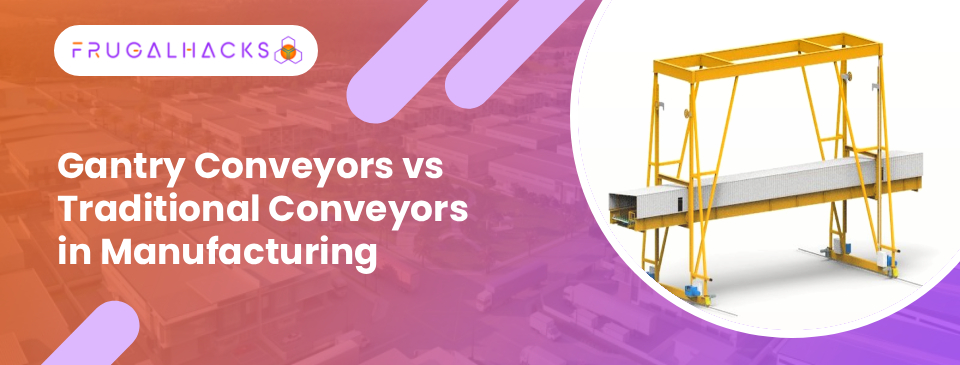
Efficient material handling is critical to modern production environments and Gantry Conveyors are increasingly becoming a strategic choice for manufacturers seeking flexible and scalable factory automation.
India’s industrial conveyor systems market was valued at nearly three hundred million dollars in 2024 and is projected to reach approximately five hundred fifty million dollars by 2033 according to industry reports. Despite this growth a large share of investment still goes toward replacing traditional belt systems instead of adopting smarter automation architectures.
Manufacturers are now asking a more strategic question. Instead of simply automating material flow they want to know which system architecture supports long term productivity layout efficiency and operational flexibility.
The Problem When Your Conveyor Becomes the Bottleneck
Traditional conveyor systems such as belt roller and chain conveyors were originally designed for simple linear material flow in high volume production lines. While effective for continuous transport these systems expose limitations in modern manufacturing environments.
Common operational challenges include
- 🏭 Permanent floor space consumption across the production line
- 🔧 Difficulty rerouting conveyors around machines or layout changes
- ⏱ Entire production segments stopping during maintenance
- 📦 Limited ability to handle irregular shaped or heavy components
Manufacturing productivity studies show that material handling inefficiencies can account for nearly twenty percent of lost production time in assembly facilities. For automotive or EV manufacturing plants operating multiple shifts this translates into significant output loss each week.
| Metric | Industry Insight |
|---|---|
| Production time lost due to material handling inefficiency | Approximately 20 percent according to manufacturing productivity studies |
| Growth rate of India’s conveyor market | About 5.7 percent CAGR through 2033 |
| Projected conveyor market size in India | Approximately 550 million dollars by 2033 |

The Solution Matching the System to the Application
Choosing between traditional conveyors and Gantry Conveyors depends on understanding the specific production environment and application requirements.
Traditional conveyor systems remain effective for certain applications
- 📦 Continuous movement of uniform products
- 📦 Packaging and warehouse sorting lines
- 📦 Bulk material transfer operations
However Gantry Conveyors provide significant advantages when manufacturing operations require precision flexible routing and optimized factory space utilization.
Servo controlled gantry systems move components along X Y and Z axes using programmable motion control. This architecture allows manufacturers to move parts above the production floor instead of across it.
- ⚙ Ideal for automotive BIW production lines
- 📐 Precision handling with repeatability below 0.1 millimeters
- 🔗 Integration with PLC systems and SCADA monitoring
- 🏭 Improved access for operators robots and production equipment
For example overhead servo gantry automation systems can transfer heavy assemblies between workstations while freeing floor space for robotic cells and operator movement.
In modern smart factories floor space is often the most valuable asset. The right material handling system does more than move parts. It improves layout efficiency and operational flexibility.
Why Gantry Conveyors Matter for India’s Manufacturing Growth
India’s manufacturing sector is expanding rapidly due to initiatives such as Make in India and Production Linked Incentive programs. These initiatives are encouraging companies to build globally competitive production facilities.
To achieve international productivity benchmarks factories must ensure internal logistics systems keep pace with faster assembly cycles.
Servo driven Gantry Conveyors integrated with IIoT sensors and PLC control systems offer several advantages
- ⚡ Up to 60 to 70 percent faster part transfer compared to manual handling
- 📊 Real time data generation for predictive maintenance
- 📈 Production uptime exceeding 95 percent
- 📉 Reduced labor dependency in material handling operations
Many manufacturing plants implementing gantry automation systems achieve return on investment within eighteen to thirty months due to increased productivity lower scrap rates and optimized floor space utilization.
Comparison Traditional Conveyors vs Gantry Conveyors
| Parameter | Traditional Conveyor | Servo Gantry Conveyor | Advantage |
|---|---|---|---|
| Floor space requirement | Large footprint across the production line | Minimal overhead structure | Gantry conveyors |
| Positioning accuracy | 2 to 5 millimeter variation | 0.05 to 0.2 millimeter servo precision | Gantry conveyors |
| Handling irregular parts | Limited capability | Flexible grippers and end effectors | Gantry conveyors |
| Installation cost | Lower initial investment | Higher initial investment | Traditional conveyors |
| Maintenance downtime impact | Entire line often stops | Segment level isolation possible | Gantry conveyors |
| Data integration capability | Basic sensor integration | Native servo and IIoT connectivity | Gantry conveyors |
Frequently Asked Questions
Can gantry conveyors be integrated with existing conveyor systems
Yes. Many manufacturing plants introduce Gantry Conveyors as a transfer layer between traditional conveyor segments. The gantry system lifts parts from one conveyor line repositions them and places them onto another production station.
Are gantry conveyor systems suitable for mid size manufacturers
Yes. The cost of servo gantry automation systems has decreased significantly due to local integration capabilities and government manufacturing incentives. Many mid size factories achieve payback within two to three years.
How can manufacturers decide which conveyor architecture is suitable
Three quick evaluation factors help determine the right solution
- ⚙ Component weight above 25 kilograms
- 📦 Complex or irregular component geometry
- 🏭 Frequent production layout changes
If these conditions exist gantry based material handling is often the better long term option.
Conclusion
The factory floor of the future will be shaped by decisions made today about automation architecture and material flow systems.
As India expands manufacturing capabilities in EV aerospace electronics and advanced engineering sectors the choice between traditional conveyors and Gantry Conveyors is becoming a strategic decision rather than a simple equipment purchase.
Factories that design intelligent flexible material handling systems will scale faster improve operational efficiency and adapt more easily to changing production requirements.
Frugalhacks works closely with manufacturing teams to evaluate material handling strategies and implement automation solutions that match real production environments.