

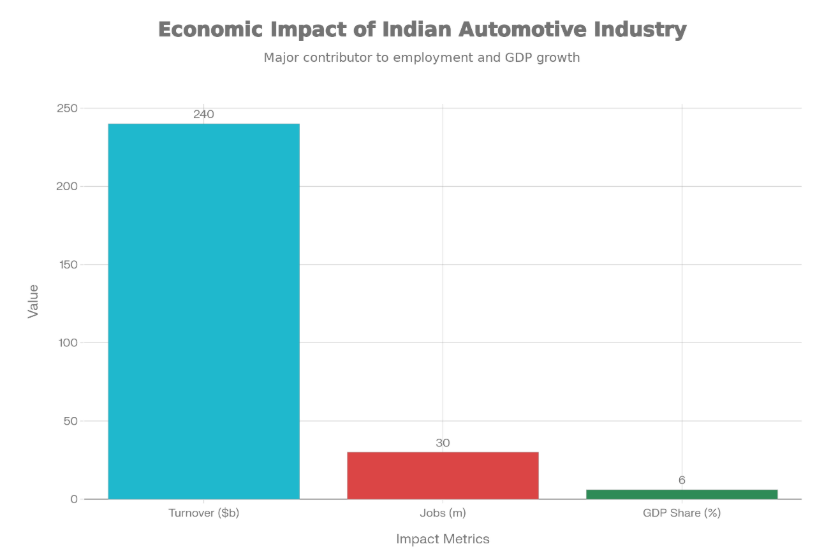
The Economic Impact of BIW Accuracy
With the auto component sector growing at 9–10% annually, precision in BIW is a major driver of national-scale savings. Even small reductions in rework translate into significant financial gains for Indian Tier-1s and OEMs.
To meet global standards, plants must now deliver repeatable accuracy that accommodates complex joining sequences and new materials like high-strength steel for EV battery trays.
Core Design Principles: The 3-2-1 Strategy
Precision begins with the fixture. Leading Indian plants utilize a consistent 3–2–1 location philosophy driven by functional datums rather than convenient geometry.
- Geofixtures vs. Respot: Key body dimensions are frozen early in geofixtures and protected from later distortion in respot fixtures.
- Weld Sequence Management: Using symmetric and staggered weld patterns minimizes heat-induced distortion, critical for tight flush conditions.
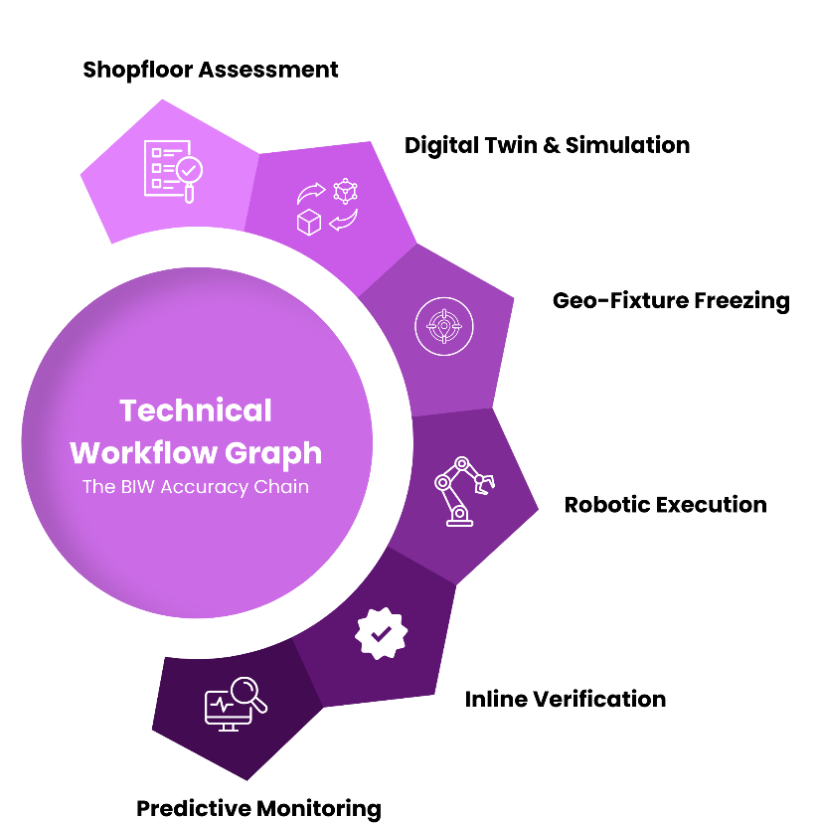
The BIW Accuracy Chain
- Shopfloor Assessment: Takt analysis and needs identification.
- Digital Twin & Simulation: Validating robot reach and heat input before building hardware.
- Geo-Fixture Freezing: Using a 3-2-1 location philosophy to lock dimensions early.
- Robotic Execution: Using symmetric weld sequences to minimize thermal distortion.
- Inline Verification: Vision-based systems checking 120+ critical points in under 15 seconds.
- Predictive Monitoring: IIoT gateways tracking clamp pressure and pin wear to prevent drift.
Smart Automation: Robotics, IIoT and Digital Twins
Automation is the backbone of modern BIW lines.
- Robotic Integration: Articulated robots and cobots replace manual welding to ensure high-repeatability joints.
- Vision Inspection: Inline laser-based systems verify hole positions and weld quality immediately.
- The Digital Twin: Simulates robot reach, clash/interference and heat input before hardware is built.
- IIoT & Predictive Maintenance: Monitoring clamp pressure and cycle counts predicts maintenance needs 40–45% before downtime.
Real-World KPIs: Reducing Rework and Cycle Time
- 30% Reduction in Cycle Time: Automation saves 30 minutes for every 100 minutes of manual labor.
- 40% Higher Quality: Optimized fixtures and inline checks significantly improve OEE.
The Frugalhacks Approach: High-End Tech, Indian Reality
Frugalhacks provides a full industrial automation stack tailored for the Indian market. Using frugal, modular fixture architectures, they enable mid-sized suppliers to reuse up to 70% of fixture investments across platforms.
Dimensional accuracy is treated as a primary KPI from digital twin simulation to on-site commissioning.
Technical BIW Engineering FAQs
- How do Indian plants achieve ±0.5mm BIW dimensional accuracy?
Through strategic 3-2-1 geo-fixture datums, symmetric weld sequencing, and inline vision systems verifying 120+ points in under 15 seconds. - What is the ROI on robotic BIW welding?
30% cycle time reduction, enabling 12,000+ additional bodies annually and eliminating ₹8–12 lakh in monthly quality costs. - How does fixture wear impact quality?
Clamp pressure decay >5% or pin wear >0.02mm reduces Cpk, predictable two weeks in advance via IIoT. - Can modular fixtures support multi-model lines?
Yes. NAAMS-grid baseplates enable model swaps in under 8 minutes while maintaining ±0.3mm capability.